Josie
Klara and the SunJosie is the Mother’s daughter, Rick’s childhood companion and Klara’s chosen human partner; her life joins the novel’s questions about illness, family responsibility, education, and the possibility of being loved beyond a body’s apparent limitations. First seen as a frail fourteen-and-a-half-year-old, she later suffers a grave collapse, recovers after the Sun shines on her, and leaves home as a young adult. Her story ends not with Klara’s replacement by a human likeness, but with an embrace and a goodbye that acknowledge both their attachment and their separation.
Identity and First Encounters
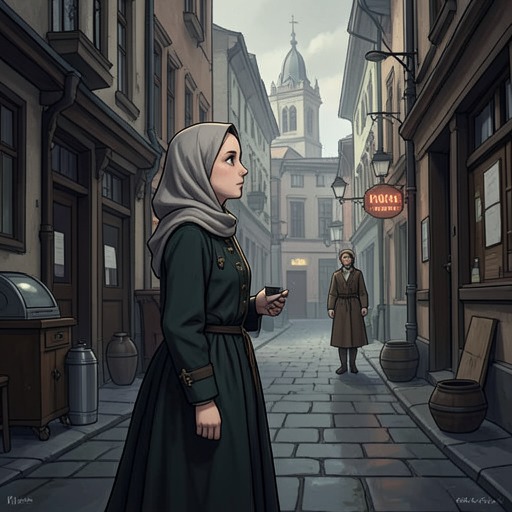
Josie first approaches the store during Klara’s fourth morning in the window. She is pale and thin, and her walk differs from that of other passers-by: she seems to assess each step to ensure she remains safe and does not fall. Klara estimates her age at fourteen and a half. Josie stops before the glass, smiles, and asks whether Klara can hear her. From the outset, their meeting is more than a prospective buyer’s inspection. Josie looks directly at Klara and addresses her as someone whose response matters.
When Josie returns with the Mother, she explains that she specifically asked for Klara and that the Mother is watching to assess the AF she has chosen. She apologizes for the scrutiny, then makes clear that she wants Klara to come only if Klara also wants to. If Klara refuses, Josie says, she will accept that decision rather than insist. Her concern for Klara’s willingness gives the selection scene a reciprocal quality: Josie is not simply choosing a companion, but trying to make sure the companion is not compelled against her will.
Later, after Klara has remained at the store, Josie comes back with Manager. Klara steps into two intersecting rectangles of sunlight, and Josie’s face fills with joy as she quickens her uncertain stride. She has become even thinner, and she stops just short of embracing Klara. The encounter makes the reunion’s happiness unmistakable while keeping Josie’s physical vulnerability in view.
Illness, Family, and the Question of Being Lifted
Josie’s illness shapes the rhythms of her life and the decisions her family makes for her. She recalls visiting Mr McBain’s shelter with Rick when they were little, before she became sick. That earlier visit locates their closeness in a shared childhood that illness has since interrupted. In another photograph, she identifies the girl beside herself and the Mother as Sal, her sister; she repeats the identification after a long silence, making clear that Sal remains part of her family history and memory.
The Mother later describes the decision to have Josie lifted as hers. After Sal, the Father had said they should not risk it; the Mother nevertheless wanted the best life for Josie and chose to go ahead. She connects that decision to Josie’s illness and tells Klara that she feels responsible for what followed. Her account makes the choice neither an abstract policy question nor an uncomplicated expression of parental ambition: it is a decision made in the hope of securing Josie’s future, carried afterward as guilt and fear.
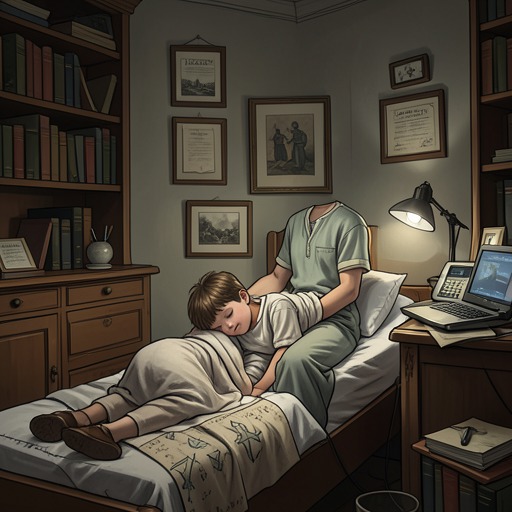
Josie’s bond with the Mother is also visible in a moment of direct terror. During a nighttime embrace, Josie clings to her mother and says that she does not want to die. The Mother answers softly and stays with her. Much later, when Josie entrusts Rick with a message for the Mother, she says she loves her, is grateful to have her as a mother, and never wished for another. She also tells her mother that, if she could decide again, she would make the same choice about being lifted. That message directly answers the Mother’s fear that her decision betrayed Josie: Josie accepts the choice as an expression of the life her mother wanted her to have.
Rick and the Future They Imagined
Rick and Josie share a history that precedes her illness, as well as a plan they sometimes invoke when imagining a future together. The plan is not a carefully worked-out arrangement. Klara gradually understands it as a vague wish, important because it gives Josie and Rick a way to picture life beyond the immediate constraints of illness, education, and loneliness. Josie’s relationship with her peers is complicated: Klara thinks she may behave strangely among them, but believes she is kind underneath, and sees the other children’s roughness as connected to their fear of loneliness. Rick worries that Josie may become like them and lose the self he recognizes.
Rick’s own future is constrained by his unlifted status. Helen explains that Atlas Brookings admits a small number of unlifted students, but that places are scarce and competition severe. TWE forbids its members to tutor unlifted children, while other screen tutors charge fees Rick’s family cannot afford. The Mother hopes Klara can help him, but Rick objects to the arrangement. At a later family gathering, the Father praises Rick’s drone work, insisting that real ability deserves recognition whether or not its maker was lifted. The praise affirms Rick’s talent but does not resolve the different educational paths now opening before him and Josie.
By the time Klara voices her concern, the contrast between those paths has become plain: Rick and Josie remain kind to each other, yet are preparing for different futures. Their earlier plan has not secured a shared destination. Josie continues working hard on tutorials, and discussions arise about which college she should attend; Atlas Brookings is rarely mentioned after Rick no longer wishes to go there. The separation is not presented as a sudden loss of affection. It is the gradual consequence of distinct decisions and opportunities, with the childhood bond still visible beneath the diverging plans.
Collapse and Recovery
Several days after the outing to Morgan’s Falls, Josie’s health collapses. The change initially resembles earlier downturns, but new symptoms appear: strange breathing and mornings when she lies with her eyes open yet seems only semi-awake. She does not respond when Klara speaks to her. The Mother begins coming to the bedroom early and repeating Josie’s name under her breath, while Dr Ryan visits every day and the Mother’s private conversations with him grow longer. Rick, who has been coming to help with lessons, loses interest in the tutorials and waits in the hall for permission to see Josie. Even then he is allowed only a few minutes at the doorway; on one occasion Josie opens her eyes and smiles at him.
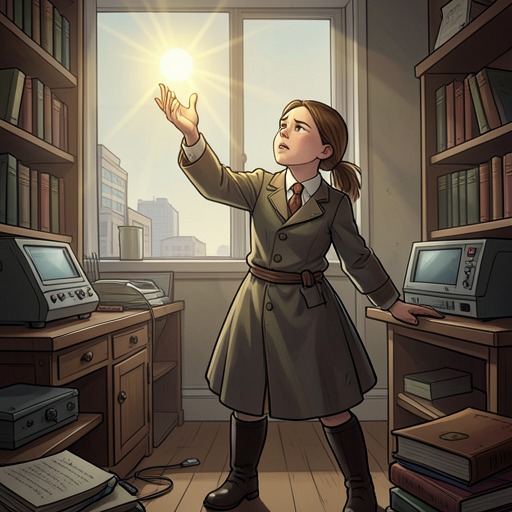
The family’s fear turns as Klara’s faith in the Sun’s nourishment is put to its decisive test. When sunlight breaks through the dark clouds, it falls over Josie and the bed in an intense orange half-disc. The Mother and Melania Housekeeper, like Rick, seem to recognize the significance of what is happening. They remain still as the light grows stronger. Josie stirs, raises a hand, and asks what the light is; soon she is sitting up against her pillows. The scene does not erase the uncertainty that preceded it, but it marks a reversal from the family’s vigil over an unresponsive child to Josie’s return to awareness.
The Sun’s special nourishment proves as effective for Josie as it had for Beggar Man. After the dark-sky morning, she grows stronger and, over the passing seasons and years, grows from a child into an adult. Her recovery is therefore not only a reprieve from an acute crisis: it makes possible a long future in which she can pursue tutorials, argue with the Mother about college, and leave home. The narrative ties her renewed life to the Sun’s intervention while preserving the fact that the family had feared she might die.
Departure and Narrative Significance
Josie eventually drives away with the Mother. Rick is not there to wave her off because he is miles away meeting new friends to discuss his hard-to-detect data-gathering devices. At the car, Josie walks across the loose stones with the same caution that has marked her gait since Klara first saw her, but she now looks excited and strong. She raises her arms into a large Y and embraces Klara for several moments, crouching because she has grown taller. Her long hair falls across part of Klara’s vision. When they separate, Josie is smiling, though Klara can also see sadness in her face.
Josie recognizes that Klara may not still be there when she returns and thanks her for being so good to her. Klara answers by thanking Josie for choosing her. Josie calls that choice an obvious one, gives her a shorter second hug, and says goodbye. As the car moves past the windy trees and over the hill, Josie waves toward Klara rather than toward the New Housekeeper. The gesture makes the departure personal: Josie is leaving home and the everyday life she shared with Klara, but does not treat their relationship as a mere phase or convenience.
Josie’s arc moves from a fragile first appearance through a life-threatening relapse to recovery, adulthood, and departure. Her continuing caution of movement contrasts with the strength she has gained, while the change in her height and long hair marks the years that have passed. Her story also unsettles any simple equation between outward survival and emotional continuity. She does not remain at home, and her future with Rick does not follow their childhood plan; nevertheless, her affection for Rick and gratitude to the Mother endure, and her final embrace confirms the importance of the bond she formed with Klara. The goodbye leaves the future beyond the scene, but makes the relationship’s past—being chosen, cared for, and choosing in return—its lasting substance.